
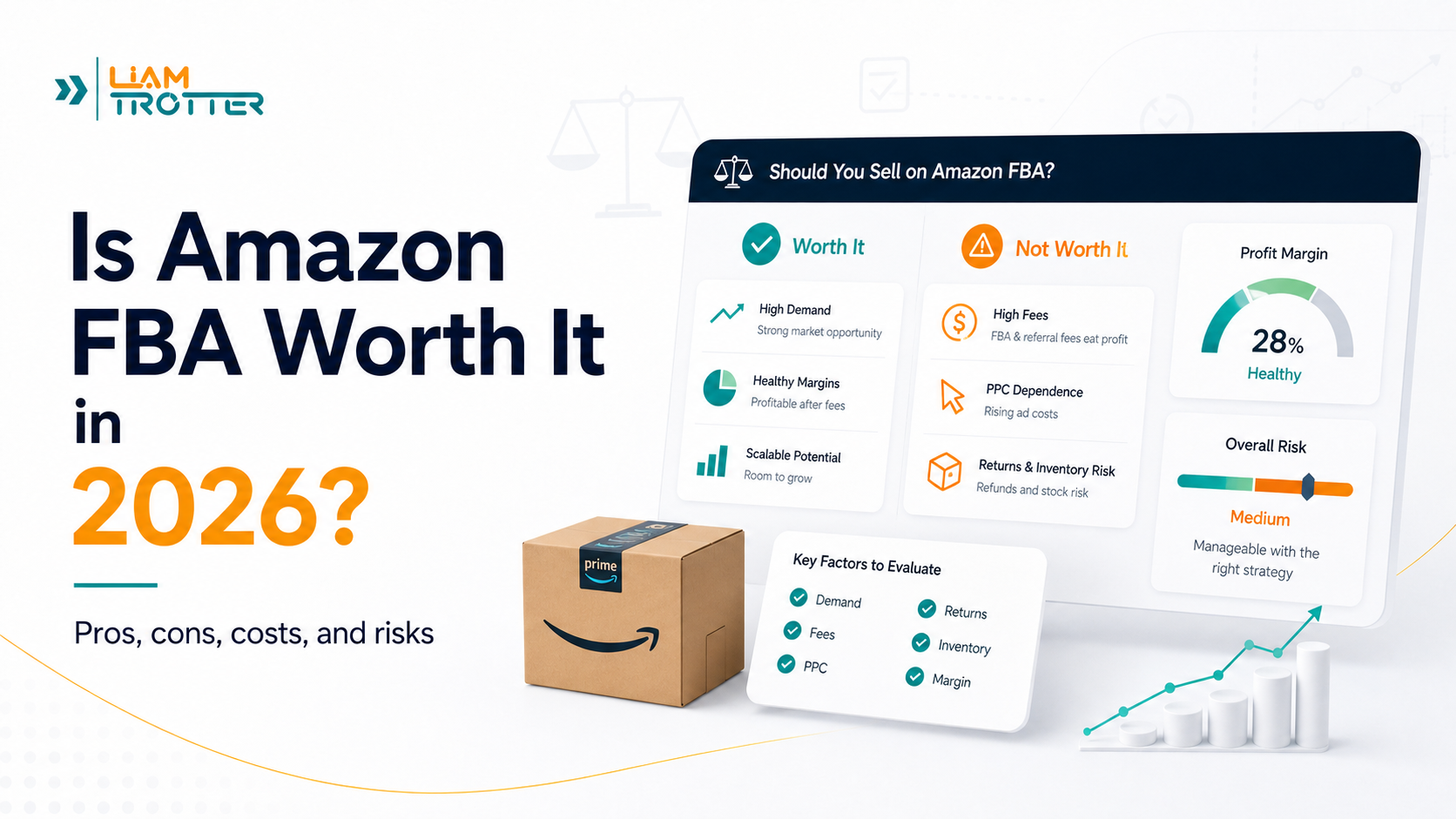

If you are thinking about starting Amazon FBA in 2026, the real question is not only whether Amazon FBA still works. The better question is this: is Amazon FBA worth it for your budget, product choice, risk tolerance, and business model?
The short answer is yes, Amazon FBA can still be worth it in 2026, but it is not easy money and it is not the right path for every beginner. The opportunity is still real, but the margin for mistakes is smaller than it used to be.
Before deciding whether Amazon FBA is worth it for you, it also helps to check whether you can register as a seller from your country. Use our Amazon seller registration countries eligibility checker to see which marketplaces may be available and what documents you may need.
Amazon is still one of the largest ecommerce platforms in the U.S., and independent sellers remain a major part of the marketplace. But higher competition, rising PPC costs, Amazon fees, storage fees, returns, and inventory risk mean new sellers need to understand the numbers before buying stock.
This guide gives you a realistic answer to the question “is Amazon FBA worth it?” in 2026, including who it is best for, who should avoid it, what the main risks are, and how to decide if FBA makes sense for your situation.
Quick Answer: Is Amazon FBA Worth It in 2026?
Yes, Amazon FBA can still be worth it in 2026, but not for every beginner and not with every product.
Amazon still controls a major share of U.S. ecommerce, accounting for about 40% of U.S. retail ecommerce sales. Independent sellers also remain central to the marketplace: Amazon says more than 60% of sales in its store come from independent sellers, and U.S.-based independent sellers averaged more than $290,000 in annual sales in 2024. More than 55,000 independent sellers generated over $1 million in sales that year.
Those numbers show that the opportunity is still real. But they do not mean Amazon FBA is easy. Revenue is not profit, and beginners still need to account for product cost, shipping, Amazon referral fees, FBA fulfillment fees, storage, PPC, returns, and inventory risk before buying stock.
The honest answer is this: Amazon FBA is worth it if you choose the right product, understand your costs, protect your margins, and treat it like a real business. It is not worth it if you expect fast money, ignore fees, or spend your full budget on inventory before validating the product. So if you are asking is Amazon FBA worth it, the answer depends on your numbers, product, and execution.
If your concern is whether Amazon FBA is legit, yes — Fulfillment by Amazon is a real Amazon program where sellers can send inventory to Amazon’s fulfillment network and let Amazon handle storage, packing, shipping, customer service, and many returns. The bigger risk is not whether FBA is real; it is choosing the wrong product, underestimating fees, or expecting easy profit without proper research.
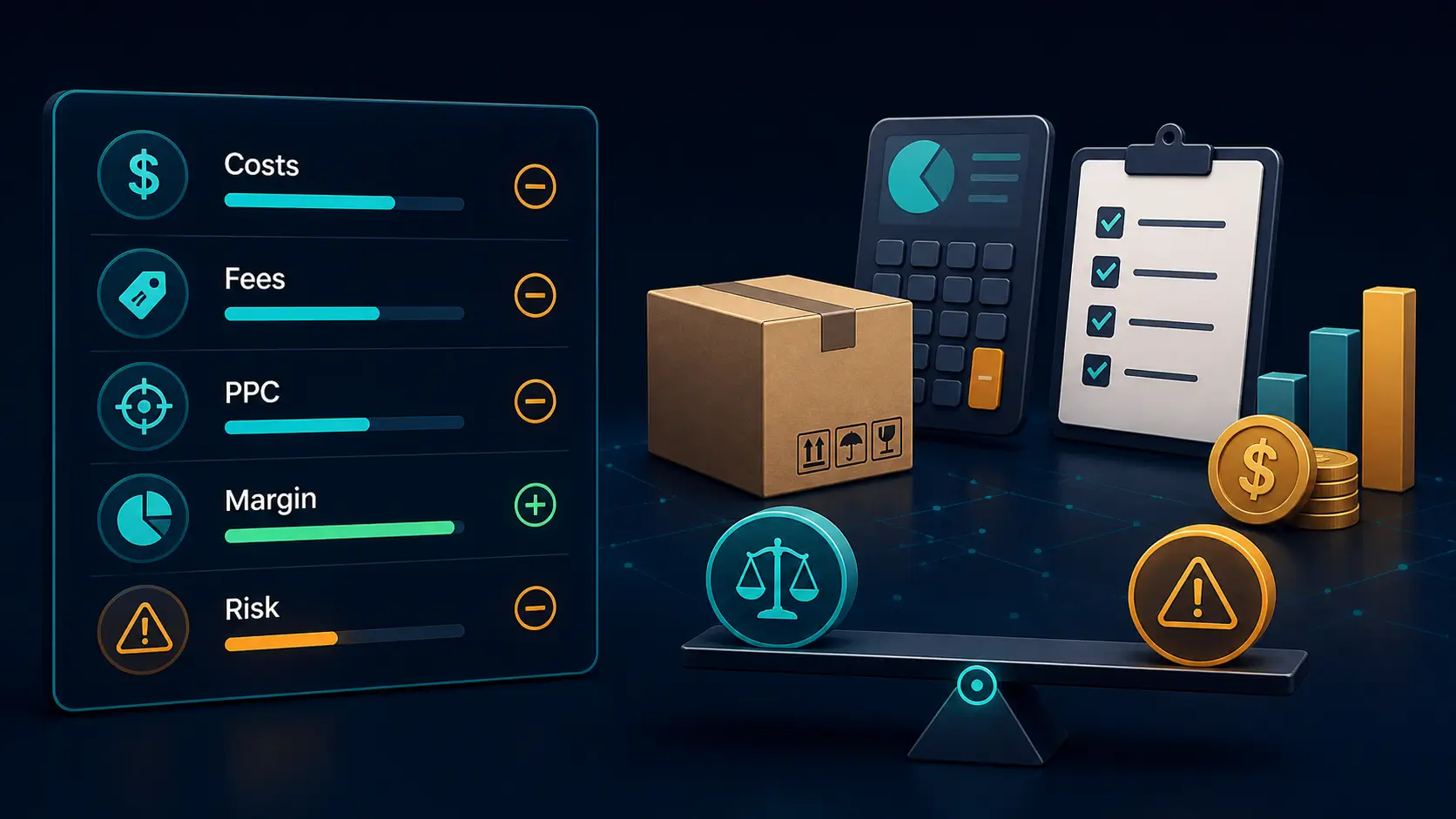
Is Amazon FBA Still Worth It?
Amazon FBA is still worth it for some sellers, but the model has changed. A few years ago, many beginners could enter the marketplace with a simple product, a basic listing, and a small advertising plan. In 2026, that approach is much harder.
The opportunity is still there because Amazon continues to attract shoppers who are ready to buy. FBA also gives sellers access to Amazon’s fulfillment network, Prime eligibility, customer service support, and a marketplace that already has massive demand.
What changed is the level of execution required. New sellers now need better product research, stronger margins, more realistic launch budgets, and a clearer plan for PPC, storage fees, returns, and inventory management.
Amazon FBA is no longer worth it for people who want to copy a random product, send inventory to Amazon, and hope sales appear. It can still be worth it for people who validate demand, understand the fees, start with a controlled inventory order, and improve the offer over time.
In simple terms, Amazon FBA is not dead. It is just less forgiving. Sellers who treat it like a real ecommerce business still have a chance. Sellers who treat it like a shortcut usually struggle. That is why the real answer to is Amazon FBA worth it is different for every seller.
Is Amazon FBA Worth It for Beginners?
Amazon FBA can be worth it for beginners, but only if they understand what they are really starting. It is not just a simple side hustle where Amazon does all the work. Amazon can handle fulfillment, storage, shipping, customer service, and returns, but the beginner is still responsible for choosing the product, calculating costs, managing inventory risk, and building a listing that can actually convert.
For a beginner, the biggest advantage of Amazon FBA is that it removes some of the hardest operational work. You do not need your own warehouse, packing team, or shipping system before you make your first sale. This can make Amazon FBA easier to start than building a full ecommerce operation from scratch.
However, that does not mean it is easy. A beginner still needs to learn product research, supplier sourcing, Amazon fees, PPC advertising, inventory planning, and profit margin analysis. If you skip those parts, FBA can become expensive very quickly.
Amazon FBA is usually more realistic for beginners who start small, choose simple products, avoid oversized or fragile items, and leave enough budget for testing. It is much riskier for beginners who spend most of their money on inventory before understanding demand, competition, fees, shipping, and advertising costs.
For beginners, asking “is Amazon FBA worth it?” too early can lead to the wrong decision. It is better to ask that question after you understand your product costs, Amazon fees, PPC needs, shipping, inventory risk, and how much budget you can afford to test.
When Amazon FBA Is Worth It
Amazon FBA is most likely to be worth it when the product, budget, and business model fit the way FBA works. It is not enough to say that Amazon has a large customer base. The product still needs enough demand, enough margin, and enough room to survive fees, PPC, returns, and storage costs.
FBA can be worth it when you have a product that is relatively simple to ship, not too fragile, not too bulky, and not too expensive to store. Small and standard-size products are often easier for beginners than heavy, oversized, or complicated products.
It can also be worth it when you have a realistic launch budget. That means you are not spending all your available cash on the first inventory order. A safer budget leaves room for samples, shipping, Amazon fees, product photos, PPC testing, and a safety buffer.
Amazon FBA is especially useful when fulfillment is holding you back. If packing, shipping, customer service, or delivery speed would limit your growth, FBA can help you operate more efficiently and give customers a better buying experience.
In short, Amazon FBA is worth it when you validate the product first, understand the costs, start with a controlled inventory order, and use FBA as part of a real ecommerce system rather than as a shortcut.
At this point, the question “is Amazon FBA worth it?” becomes less about Amazon itself and more about whether your product, budget, margin, and execution are strong enough.
When Amazon FBA Is Not Worth It
Amazon FBA is not worth it when the numbers do not work. A product can look attractive because it has demand, but if the margin is too thin after product cost, shipping, referral fees, FBA fees, storage, PPC, and returns, the business can become stressful very quickly.
It is also not worth it when a beginner is trying to move too fast. Buying a large inventory order before testing demand, checking competition, or understanding fees can lock too much cash into a product that may not sell as expected.
Amazon FBA may be a poor fit for products that are oversized, fragile, low-margin, slow-moving, or likely to have high return rates. These products can create higher storage costs, more fulfillment risk, and more cash flow pressure.
FBA is also not ideal if you want full control over packaging, customer communication, returns, or the post-purchase experience. Amazon handles many parts of fulfillment, but that convenience also means you give up some control.
The clearest warning sign is simple: if you only have enough money to buy inventory, you probably do not have enough money for a serious FBA launch. You still need room for shipping, listing assets, PPC testing, Amazon fees, returns, and unexpected delays.
Is Amazon FBA Still Profitable in 2026?
Amazon FBA can still be profitable in 2026, but profitability depends on the difference between revenue and real profit. A seller can generate sales and still lose money if the product has weak margins, expensive PPC, high storage costs, or frequent returns.
This is one of the biggest mistakes beginners make. They look at the selling price and product cost, then assume the remaining amount is profit. In reality, an Amazon FBA seller also needs to account for referral fees, FBA fulfillment fees, inbound shipping, storage fees, product photos, software tools, PPC, returns, damaged units, and cash tied up in inventory.
Amazon FBA is more likely to be profitable when the product has strong demand, a healthy margin, manageable competition, and a clear reason for customers to choose it over similar listings. It is less likely to be profitable when the product is generic, expensive to ship, easy to copy, or dependent on aggressive advertising just to get sales.
The question is not only “Can Amazon FBA make money?” A better question is: Can this specific product stay profitable after Amazon fees, PPC, shipping, storage, and returns?
For beginners, the safest approach is to test carefully, keep the first inventory order controlled, and avoid judging success by sales volume alone. Higher sales are useful only if the product still leaves enough profit after all major costs are included.
What Reddit Gets Right and Wrong About Amazon FBA
If you search Reddit for whether Amazon FBA is worth it, you will usually find mixed opinions. Some sellers say FBA still works if you understand the numbers. Others say it is too competitive, too expensive, or too risky for beginners.
You will also find mixed Amazon FBA reviews across blogs, YouTube, forums, and seller communities. Some reviews focus on success stories, while others focus on failed launches, high PPC costs, inventory problems, or unrealistic expectations. Treat these reviews as useful warnings, but do not make your decision from one seller’s experience alone.
Some of those negative experiences are worth taking seriously. Many sellers do struggle with thin margins, high PPC costs, storage fees, returns, supplier problems, and products that looked profitable before all costs were included.
Where Reddit is often right is in warning beginners not to believe the hype. Amazon FBA is not passive income, and it is not a guaranteed way to make money. If you choose a weak product, overpay for inventory, ignore fees, or launch without a plan, FBA can become expensive very quickly.
Where Reddit can be misleading is that one seller’s bad experience does not mean the entire model is dead. A private-label seller, a retail arbitrage seller, a wholesale seller, and an FBM seller can all have very different results. Some products fit FBA well, while others may be better fulfilled by the seller or avoided completely.
The balanced takeaway is this: Reddit is useful for understanding the risks, but it should not be your only source of judgment. Use real seller experiences as warnings, then make your decision based on your product, budget, margins, fulfillment costs, and risk tolerance.
Amazon FBA Pros and Cons
Amazon FBA has real advantages, but those advantages come with trade-offs. The key is not to ask whether FBA is good or bad in general. The better question is whether the benefits are strong enough for your specific product, budget, and fulfillment needs.
This is why the answer to is Amazon FBA worth it depends on both the advantages and the trade-offs, not only on Amazon’s size or popularity.
| Amazon FBA pros | Why it matters |
|---|---|
| Amazon handles fulfillment | You do not need to pack and ship every order yourself. |
| Prime eligibility | Prime delivery can improve trust and conversion for some products. |
| Customer service support | Amazon handles many customer service and return processes for FBA orders. |
| Scalability | FBA can make it easier to handle more orders without building your own warehouse operation. |
| Less operational work | You can spend more time on product research, listing optimization, sourcing, and marketing. |
| Amazon FBA cons | Why it matters |
|---|---|
| FBA fees | Fulfillment, referral, storage, and other fees can reduce margins quickly. |
| Inventory risk | Cash can get stuck in products that sell slowly or fail to perform. |
| Less control | Amazon controls fulfillment, many returns, and parts of the customer experience. |
| Storage costs | Slow-moving or oversized products can become expensive to hold in Amazon warehouses. |
| Competition and PPC | Many products need advertising to gain visibility, and PPC can hurt profit if margins are weak. |
For many beginners, the benefits are strongest when the product is simple, lightweight, reasonably priced, and has enough margin to absorb fees and advertising. The downsides become more serious when the product is bulky, fragile, slow-moving, low-margin, or highly competitive.
This is why Amazon FBA should not be judged only by its convenience. Convenience is valuable, but only if the numbers still work after all major costs are included.
Main Amazon FBA Costs and Risks to Consider
Before deciding whether Amazon FBA is worth it, you need to understand the main costs and risks behind the model. A product can look profitable at first, but the numbers can change once you include inventory, shipping, Amazon fees, PPC, returns, and storage.
Startup Budget and Inventory Costs
Your startup budget usually begins with product samples, your first inventory order, supplier shipping, packaging, inspection, product photos, tools, and a safety buffer. For private-label beginners, inventory is often the largest cost, but it should not consume the entire budget.
If you spend almost everything on inventory, you may not have enough money left for shipping changes, listing improvements, PPC testing, or unexpected delays. A safer first launch keeps the inventory order controlled and leaves enough cash to adjust if something goes wrong.
Before buying stock, you can use our Amazon FBA cost calculator to estimate your launch budget, inventory, shipping, PPC, tools, and safety buffer.
For a deeper breakdown of startup budget ranges, read our full guide on how much it costs to start Amazon FBA.
Amazon FBA Fees and Storage Costs
Amazon FBA fees can include referral fees, fulfillment fees, monthly storage fees, inbound placement costs, return-related fees, removal fees, and other charges depending on the product and marketplace. These fees can reduce your margin if you do not include them before choosing a product.
Storage is especially important for slow-moving products. If inventory stays in Amazon fulfillment centers too long, storage costs can increase and cash can get stuck in products that are not selling fast enough.
To understand these charges in more detail, read our full guide to Amazon FBA fees. For product-level estimates, you can also compare fulfillment options with Amazon’s official Revenue Calculator.
PPC, Returns, and Cash Flow Risk
PPC can help a new listing get visibility, but it can also expose weak margins quickly. A product with good demand may still become unprofitable if each sale requires too much advertising spend.
Returns are another risk. Amazon’s customer-friendly return process can support buyer trust, but sellers still need to account for returned units, damaged inventory, refund-related costs, and lower cash flow.
The main risk is not one single fee. The real risk is underestimating the combined pressure of inventory, shipping, FBA fees, PPC, storage, returns, and delayed cash recovery. That is why Amazon FBA is usually safer when you start with a controlled budget and a product that can survive mistakes.
Who Should Start Amazon FBA?
Amazon FBA may be a good fit for people who are willing to treat it like a real ecommerce business. The best beginners are not usually the ones looking for the fastest shortcut. They are the ones who are patient enough to research products, compare numbers, test carefully, and improve over time.
Part of treating Amazon FBA like a real business is choosing the right setup for your stage. If you are still unsure whether to start as an individual or form a company, read our guide on whether you need an LLC to sell on Amazon.
You may be a good fit for Amazon FBA if you are comfortable working with data. That includes checking demand, estimating fees, comparing competitors, calculating margins, and making decisions based on numbers rather than excitement alone.
Amazon FBA can also make sense if you have enough capital to test properly. You do not need an unlimited budget, but you do need more than just inventory money. A serious launch should leave room for shipping, listing assets, PPC testing, tools, and a safety buffer.
It is also better suited to people who can handle uncertainty. Your first product may not work. Your PPC may need adjustments. Your supplier may cause delays. Your listing may need improvement. If you can learn from those problems without panicking, you are more likely to make good decisions.
In simple terms, Amazon FBA is best for beginners who are willing to learn, test, manage risk, and think long term.
Who Should Avoid Amazon FBA?
Amazon FBA is not a good fit for everyone. If you are looking for fast income, passive profit, or a business where Amazon does all the hard work, FBA will probably disappoint you.
You should avoid Amazon FBA if you are not willing to learn the numbers. Product cost, shipping, referral fees, fulfillment fees, storage, PPC, returns, and cash flow all matter. If you ignore those costs, a product that looks profitable can quickly become a bad launch.
FBA may also be a poor fit if your budget is too tight. If your entire budget only covers the first inventory order, you may not have enough room for samples, shipping, listing assets, PPC testing, or unexpected problems.
You should also be careful if you dislike product research, supplier communication, inventory planning, or ongoing optimization. Amazon FBA can reduce fulfillment work, but it does not remove the need to manage the business.
The clearest sign to avoid FBA is this: if you are depending on one product to work immediately because you cannot afford mistakes, the risk is probably too high.
Amazon FBA vs Other Selling Models
Amazon FBA is not the only way to sell online. Whether it is worth it depends partly on which selling model you compare it with. A beginner doing retail arbitrage has different risks from a private-label seller, and an FBM seller has different responsibilities from an FBA seller.
Amazon FBA vs FBM
With FBA, Amazon stores your inventory and handles picking, packing, shipping, customer service, and many returns. This can save time and may improve conversion through Prime eligibility, but it also adds fulfillment fees, storage fees, and less control over the customer experience.
With FBM, you fulfill orders yourself or through your own logistics setup. This gives you more control over packaging, customer communication, and some returns, but it also means you must manage shipping speed, customer service, and fulfillment operations.
FBA may work better for small, standard-size, fast-moving products. FBM may make more sense for larger, fragile, high-value, slower-moving, or custom-packaged products where control matters more than convenience.
Retail Arbitrage vs Private Label
Retail arbitrage can be a lower-cost way to learn how Amazon works because you buy discounted products from stores and resell them on Amazon. It can help beginners understand scanning, pricing, fees, and demand without building a brand from scratch.
Private label usually has more upside, but it also requires more planning, capital, and risk. You may need samples, suppliers, packaging, product photos, listing optimization, PPC, and a larger inventory order before you know whether the product will perform.
This is why Amazon FBA can mean very different things depending on the model. A beginner testing books or retail arbitrage is not taking the same risk as someone launching a full private-label product with thousands of dollars in inventory.
Amazon FBA vs Shopify
Amazon FBA gives you access to an existing marketplace with buyer demand, but you are operating inside Amazon’s rules, fees, and competition. Shopify gives you more brand control, but you need to build your own traffic, trust, checkout experience, and fulfillment system.
For many beginners, Amazon can be easier to test because shoppers are already searching for products. Shopify can be better for long-term brand control, but it often requires stronger marketing skills and a separate traffic strategy.
The best choice depends on your product, budget, skills, and goals. Amazon FBA is not automatically better or worse than other models. It is worth it only when the model fits your numbers and your ability to execute.
Frequently Asked Questions
Here are some common questions beginners ask before deciding whether Amazon FBA is still worth starting in 2026.
Amazon FBA can be worth it for beginners who are willing to research products, understand fees, manage inventory risk, and start with a realistic budget. It is not ideal for beginners who expect fast income or want Amazon to do all the business work for them.
Yes, Amazon FBA can still be profitable in 2026, but profit depends on product cost, selling price, Amazon fees, shipping, storage, PPC, returns, and competition. Revenue alone does not mean profit.
Yes, Amazon FBA is legit. Fulfillment by Amazon is a real Amazon program that lets sellers send inventory to Amazon’s fulfillment network so Amazon can handle storage, packing, shipping, customer service, and many returns.
The main risk is not whether FBA is real. The risk is choosing the wrong product, ignoring fees, spending too much on inventory, or expecting quick profit without proper research.
Reddit opinions are mixed. Some sellers say Amazon FBA is still worth it if you understand the numbers, while others warn about fees, competition, PPC, returns, and inventory risk.
The most balanced view is that Reddit is useful for understanding risks, but your decision should depend on your product, budget, margins, fulfillment costs, and risk tolerance.
Amazon FBA reviews can be useful, but they are often based on one seller’s experience. Some reviews focus on success stories, while others focus on failed products, high ad costs, storage fees, or poor margins.
Use reviews as warnings and learning material, but make your decision based on your own product, budget, costs, competition, and risk tolerance.
There is no single required amount. A small budget may be enough for learning, samples, or a lean test, but many private-label beginners need more room for inventory, shipping, product photos, PPC, tools, and a safety buffer.
The key is not only the total budget, but how safely that budget is distributed.
It is possible to make $1,000 a month selling on Amazon, but it is not guaranteed. Your results depend on product demand, margin, competition, advertising costs, inventory control, and how well you manage the business.
Beginners should focus first on learning the numbers and avoiding costly mistakes.
The success rate of Amazon FBA varies widely because sellers use different business models, budgets, products, and strategies. A retail arbitrage seller, wholesale seller, and private-label seller may have very different results.
Success usually depends on product selection, margins, fee control, PPC, and inventory management.
The main disadvantages of Amazon FBA include fulfillment fees, referral fees, storage costs, return risk, inventory risk, less control over customer experience, and strong competition.
FBA is convenient, but that convenience only helps if the product still has enough margin after all costs are included.
Amazon FBA is competitive in 2026, especially for generic products with weak differentiation. However, that does not mean every opportunity is gone.
Sellers still have a better chance when they choose simple products, understand customer demand, protect margins, and avoid copying crowded listings.
After looking at the costs, risks, pros, cons, and business models, the question is Amazon FBA worth it has a clearer answer: it depends on whether you can make the numbers work before you scale.
Final Verdict: Is Amazon FBA Worth It in 2026?
So, is Amazon FBA worth it in 2026? For the right seller, yes, but it is not the easy opportunity some beginners expect. The marketplace is more competitive, fees matter more, PPC can be expensive, and weak products are much harder to launch successfully.
The opportunity is still real because Amazon has massive demand, strong customer trust, Prime eligibility, and a fulfillment system that can help sellers scale. But those advantages only matter if the product has enough margin, the budget is realistic, and the seller understands the risks before buying inventory.
So the final answer is simple: Amazon FBA is worth it if you treat it like a real business. That means researching carefully, starting with a controlled budget, understanding fees, testing PPC, protecting cash flow, and improving your product and listing over time.
Amazon FBA is not worth it if you expect quick money, choose products blindly, ignore fees, or spend your full budget on inventory before validating demand.
If you are still learning the full process, start with our complete guide on how to sell on Amazon FBA. If your main concern is budget, use the Amazon FBA cost calculator before buying inventory.
