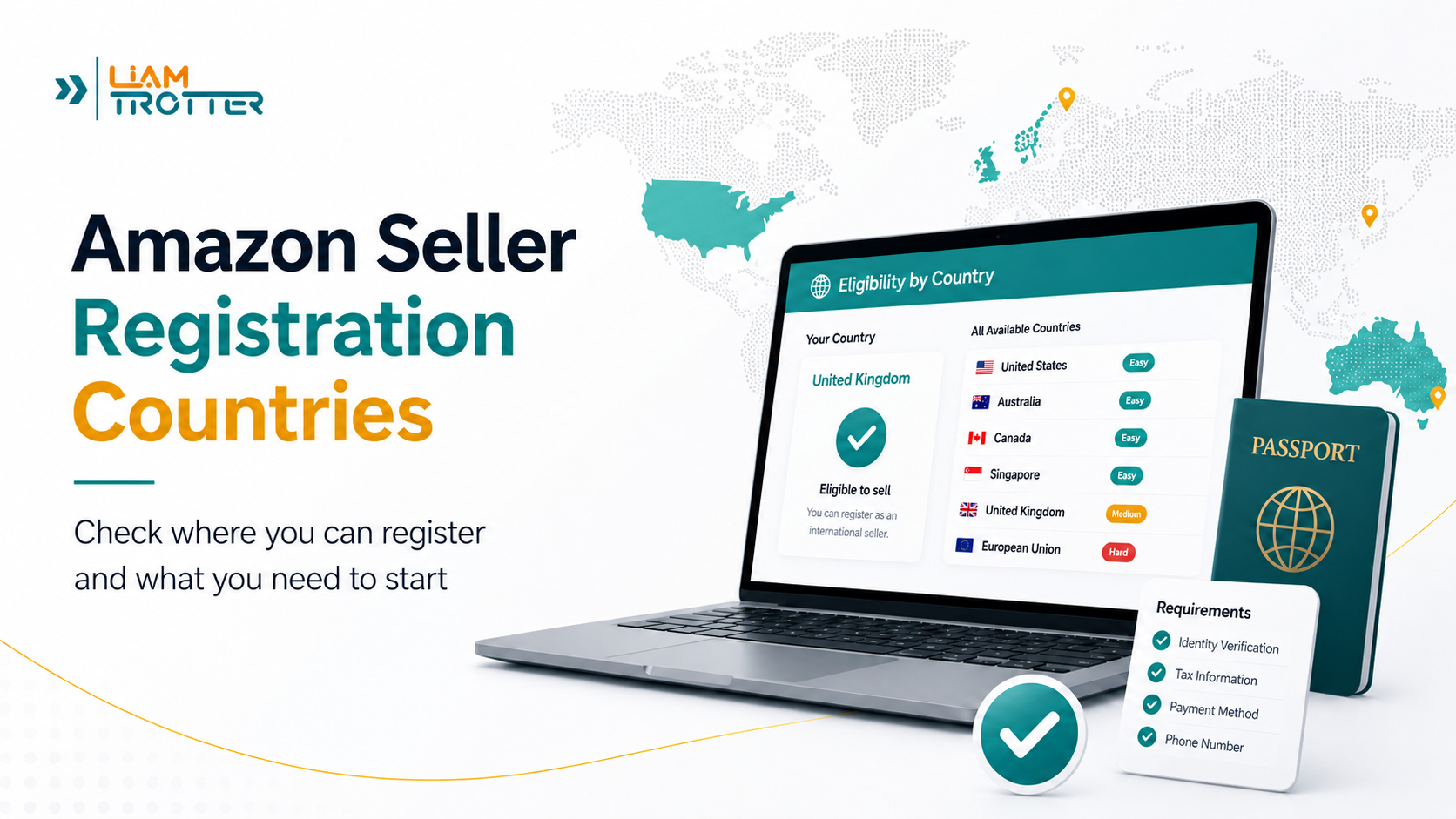

If you want to sell on Amazon, the first question is simple: can you register for an Amazon seller account from your country?
Amazon maintains an official list of countries accepted for seller registration. If your country is on that list, you can generally start the seller account registration process, but approval is not automatic. You still need to pass Amazon’s identity verification, provide a valid phone number, use an internationally chargeable payment method, set up a supported payout method, and complete any required tax information.
This guide helps you check whether your country is on Amazon’s accepted seller registration country list, understand the difference between an accepted country and an Amazon marketplace, compare possible marketplace options, and decide what to do next.
Important: this page is not an official Amazon page. Use it as a planning guide, then confirm the latest requirements on Amazon Seller Central before registering.
Quick Answer: What Are Amazon Seller Registration Countries?
Amazon seller registration countries are the countries Amazon currently accepts for creating a seller account. Being on the accepted country list means residents can generally start the registration process, but they still need to meet Amazon’s verification, payment, payout, phone, document, and tax requirements.
It is also important to understand that an accepted registration country is not the same thing as an Amazon marketplace. For example, your country may be accepted for seller registration even if Amazon does not have a local marketplace in your country. In that case, you may still be able to sell through marketplaces such as Amazon US, Amazon UK, Amazon Germany, Amazon UAE, or others, depending on your situation.
Official source note: This checker is based on Amazon’s official Countries accepted for seller registration guidance, combined with practical notes for beginners.
Last reviewed: June 2026. Because Amazon’s registration rules, verification requirements, tax rules, and payout options can change, always confirm the latest details inside Amazon Seller Central before creating your account.
Amazon Seller Registration Eligibility Checker 2026
Use the checker below to see whether your country is on Amazon’s accepted seller registration country list. Then compare possible marketplace options, document requirements, payout considerations, tax notes, and the next step before creating your seller account.
Check whether your country is on Amazon’s accepted seller registration country list, compare marketplace options, and understand which documents or tax requirements may apply.
Start typing your country name, then choose it from the suggestions.
Accepted Country vs Amazon Marketplace: What Is the Difference?
An Amazon seller registration country is a country Amazon may accept for creating a seller account. An Amazon marketplace is an Amazon store where customers can shop, such as Amazon US, Amazon UK, Amazon Germany, Amazon UAE, Amazon Saudi Arabia, or Amazon Egypt.
These are not the same thing.
Your country may be accepted for seller registration even if Amazon does not have a local marketplace in your country. For example, a seller from an accepted country may still choose to compare Amazon US, Amazon UK, Amazon Europe, Amazon UAE, Canada, Australia, or another marketplace depending on documents, payout options, tax requirements, language, shipping, and business goals.
This is why checking the accepted countries list is only the first step. You also need to understand which marketplace is realistic for your situation, whether you can receive payouts, what documents Amazon may request, and whether tax or business registration requirements apply.
In simple terms:
- Accepted registration country: where the seller is allowed to start the registration process.
- Amazon marketplace: the Amazon store where the seller wants to list and sell products.
- Account approval: Amazon’s final decision after identity, address, phone, payment, payout, and tax checks.
Being on the accepted countries list can let you begin the process, but it does not guarantee account approval or mean every marketplace will be equally easy to use.
Popular Country Checks
Many beginners search for country-specific Amazon seller registration information before creating an account. Common examples include whether sellers from Algeria, Morocco, Pakistan, Egypt, the UAE, Saudi Arabia, India, the United Kingdom, or the United States can register and which marketplace may be easier to compare first.
The checker above is designed to help you start that research. Type your country of residence, review the result, then confirm the latest accepted country status and marketplace requirements inside Amazon Seller Central before opening your account.
If your country appears on the accepted seller registration country list, the next step is not to buy inventory. The next step is to prepare your documents, understand your payout options, choose a realistic marketplace, and create your Amazon seller account carefully.
If your country appears on Amazon’s accepted seller registration country list, the next step is to prepare your documents and follow the account setup process carefully. You can read the full step-by-step guide here: how to create an Amazon seller account.
What Are Amazon Seller Registration Countries?
Amazon seller registration countries are the countries and regions where Amazon allows people or businesses to start the seller account registration process.
In simple terms, your country of residence matters. If your country is accepted for seller registration, you may be able to create an Amazon seller account as long as you can also meet Amazon’s identity, payment, tax, phone, and document verification requirements.
Amazon maintains its own official list of countries accepted for seller registration. That list can change over time, so you should always confirm the latest requirements directly on Amazon Seller Central before making business decisions.
In other words, this is often called the Amazon seller supported countries list, Amazon approved countries list, or list of countries accepted for seller registration. The wording can vary, but the question is the same: does Amazon currently allow sellers from your country to start registration and pass verification?
Being in an accepted country does not automatically mean every marketplace will be equally easy for you. For example, one seller may be able to register for Amazon US with a simple tax form, while another marketplace may require VAT registration, local tax information, business documents, or a specific payout setup.
That is why this page does more than list countries. The eligibility checker helps you understand which marketplaces may be available, how difficult they may be, and what documents or setup steps you may need before starting.
Can You Sell on Amazon From Any Country?
No, you cannot sell on Amazon from every country in the same way.
Amazon seller registration depends on whether your country is accepted, whether you can verify your identity, whether you have a valid phone number, whether you can use an accepted payment method, and whether you can provide the required tax or business information.
Some countries may be accepted for seller registration. Others may be restricted because of trade rules, banking limitations, identity verification issues, or Amazon’s own registration policies.
This is why beginners should check eligibility before spending money on product samples, inventory, tools, or shipping. If you cannot register properly or receive payouts, the rest of the Amazon FBA plan does not matter yet.
The safest approach is to check your country first, then choose the marketplace that gives you the simplest and most realistic path to registration.
What This Amazon Seller Eligibility Checker Shows You
This Amazon seller eligibility checker is designed to help beginners answer several practical questions before starting.
It shows whether your country is on Amazon’s accepted seller registration country list, which Amazon marketplaces may be realistic to compare, and which marketplace may be easier to start with.
It also gives each marketplace a difficulty level, such as easy, medium, medium-hard, or hard. This helps you compare options instead of assuming every Amazon marketplace has the same requirements.
The tool also shows possible tax requirements, estimated setup complexity, documents you may need, bank account or payout considerations, and official Seller Central links for each marketplace.
The goal is not to make the decision for you. The goal is to help you understand the path before you spend money.
What Do You Need to Register as an Amazon Seller?
The exact requirements can vary by country and marketplace, but most new sellers should expect to prepare a few core items.
You will usually need a valid government ID, such as a passport or national ID card. Amazon may also ask for proof of address, such as a recent utility bill or bank statement.
You will also need a valid phone number for verification, a working email address, and a chargeable credit card or accepted payment method for seller account fees.
You may need a bank account or payout method that Amazon supports for your marketplace. For international sellers, this is often one of the biggest practical questions because your local bank may not always be the easiest way to receive payouts from Amazon.
Tax information is also important. For example, non-US sellers registering for Amazon US may usually complete a tax interview and submit the appropriate tax form. Other marketplaces may involve VAT, GST, or local tax registration depending on where you sell and where you store inventory.
If you register as a business, Amazon may ask for business documents. If you register as an individual, the requirements may be simpler, but this depends on your country, marketplace, and situation.
Do You Need a Company or LLC to Sell on Amazon?
In many cases, you may be able to register as an individual seller without forming a company first.
This is especially important for beginners. Many people think they must open a US LLC or register a company before they can even start. That is not always true.
For a deeper breakdown, read our full guide on whether you need an LLC to sell on Amazon. It explains when you can usually start as an individual and when forming a company may be worth considering.
However, there are cases where a company, LLC, business license, or business documents may be useful or required. This can depend on your target marketplace, tax situation, payout method, product category, local regulations, and long-term business plans.
For example, a beginner selling as an individual on one marketplace may have a simpler setup than a seller who wants to store inventory in Europe, register for VAT, open a business bank account, or build a larger brand.
The best way to think about it is this: you do not always need a company to start researching Amazon, but you may need one depending on how and where you plan to sell.
This page gives you a starting point. For legal, tax, or company formation decisions, always speak with a qualified professional.
Can a Non-US Citizen Sell on Amazon?
Yes, many non-US citizens can sell on Amazon if their country is accepted for seller registration and they can meet Amazon’s verification requirements.
You do not usually need to be a US citizen to sell on Amazon US. Many international sellers use Amazon US because it has a large customer base, strong demand, and a relatively familiar registration process compared with some other marketplaces.
However, being a non-US citizen still means you need to prepare the right documents. You may need identity verification, proof of address, a valid phone number, an accepted payment method, a payout solution, and tax information.
The US marketplace may be a good starting point for many international beginners, but it is not automatic. You still need to pass Amazon’s account verification and understand your tax and payout setup.
Which Amazon Marketplace Should Beginners Start With?
For many international beginners, Amazon US is often the simplest marketplace to consider first.
The US marketplace has strong demand, a large customer base, many available tools, and a relatively common path for international sellers. It is also the marketplace most Amazon FBA education and software tools are built around.
That does not mean Amazon US is always the best choice for everyone. Some sellers may prefer Amazon UK, Canada, Australia, Singapore, UAE, Saudi Arabia, Egypt, or Europe depending on their location, language, product, logistics, tax situation, and target customers.
Amazon UK and Europe can be attractive, but VAT and cross-border compliance may make them harder for beginners. UAE, Saudi Arabia, and Egypt may be useful for sellers targeting the Middle East, but local business and tax requirements can vary.
The best starting marketplace is usually the one where you can register legally, verify your account smoothly, receive payouts, understand the tax requirements, and test products without taking on unnecessary complexity.
Which Arab Countries Have Amazon Marketplaces?
Amazon currently has dedicated marketplaces in the Middle East, including the United Arab Emirates, Saudi Arabia, and Egypt.
These marketplaces can be important for sellers who want to target Arabic-speaking customers or sell within the MENA region.
However, having a local Amazon marketplace does not always mean it is the easiest marketplace for every beginner. Some sellers from Arab countries may still find Amazon US easier to start with, depending on their documents, payout method, tax situation, suppliers, and target products.
For example, a seller from Algeria, Morocco, Tunisia, Jordan, or Lebanon may want to compare Amazon US, UAE, Saudi Arabia, Egypt, UK, Canada, Australia, and Singapore before choosing where to start.
A seller in Morocco may not have the same registration path as a seller in Egypt, the UAE, or Saudi Arabia. The best option depends on whether your country is accepted for seller registration, which documents Amazon can verify, and which payout or tax setup works for your situation.
The right choice depends on more than geography. It depends on registration difficulty, taxes, shipping, banking, competition, and how comfortable you are managing the marketplace.
What If Your Country Is Not Accepted?
If your country is not accepted for Amazon seller registration, do not rush into risky shortcuts.
Avoid buying seller accounts, using someone else’s identity, or using account setup methods that may violate Amazon’s policies. These shortcuts can put your money, inventory, and account at risk.
The first step is to check Amazon’s official accepted country list and confirm whether your country is currently supported. Requirements can change, so it is worth checking the official source.
If your country is not supported and you are serious about selling, speak with a qualified legal or tax professional about lawful business setup options. In some cases, a legal business structure in an accepted country may be possible, but this depends on your situation and should not be handled casually.
If the setup is too complex, it may be better to wait, learn the business model, research products, and prepare your budget before taking action.
Eligibility Is Only the First Step
Checking whether you can register is only the first step.
After that, you still need to understand how Amazon FBA works, how much money you may need to start, whether the business model is worth it for your situation, and how to choose a product that can survive fees, shipping, PPC, returns, and competition.
Before buying inventory, you should understand the full process from seller account setup to product research, sourcing, listing creation, shipping, launch, advertising, and cash flow.
If you are new, start with the complete guide on how to sell on Amazon FBA. Then use the Amazon FBA cost calculator to estimate your budget before placing an inventory order.
You should also read the guide on whether Amazon FBA is worth it in 2026 so you understand the risks before committing money.
Amazon Seller Registration Countries FAQ
Common questions about Amazon accepted countries, approved country lists, marketplace options, and seller registration requirements.
Amazon seller registration countries are the countries and regions Amazon currently accepts for creating a seller account. If your country is on Amazon’s accepted seller registration country list, you can generally start the registration process.
However, being in an accepted country does not guarantee account approval. You still need to pass Amazon’s identity verification, provide a valid phone number, use an accepted payment method, set up a supported payout method, and complete any required tax information.
The Amazon approved countries list usually refers to Amazon’s official list of countries accepted for seller registration. Some people also call it the Amazon seller countries list, Amazon accepted countries list, or countries allowed to sell on Amazon.
The most accurate phrase is “countries accepted for seller registration,” because this list is about where a seller can register from. It does not automatically mean every country has its own Amazon marketplace or that every seller account will be approved.
Countries allowed to sell on Amazon are countries that Amazon currently accepts for seller registration, as long as the seller also meets Amazon’s verification, payment, payout, phone, document, and tax requirements.
The accepted country list can change, so the safest approach is to use this page for planning and then confirm the latest status directly inside Amazon Seller Central before creating your account.
No. An accepted registration country is where the seller lives or registers from. An Amazon marketplace is the Amazon store where customers shop, such as Amazon US, Amazon UK, Amazon Germany, Amazon UAE, Amazon Saudi Arabia, or Amazon Egypt.
Your country may be accepted for seller registration even if Amazon does not have a local marketplace in your country. In that case, you may still compare other marketplaces depending on your documents, payout method, tax situation, language, shipping plan, and business goals.
Yes, in many cases. Your country does not need to have its own Amazon marketplace for you to register as a seller. What matters first is whether your country is accepted for Amazon seller registration.
For example, a seller from an accepted country may compare Amazon US, UK, EU, UAE, Saudi Arabia, Egypt, Canada, Australia, Singapore, or another marketplace depending on the seller’s documents, payout options, tax requirements, and product strategy.
Sellers from many countries can start Amazon seller registration if their country appears on Amazon’s accepted seller registration country list and they can meet Amazon’s verification requirements.
The important point is to check your exact country, then confirm the latest Amazon rules before opening the account. After that, compare which marketplace is realistic for your situation, such as Amazon US, UK, UAE, Saudi Arabia, Egypt, Canada, Australia, or Singapore.
Yes, many non-US citizens can sell on Amazon US if their country is accepted for seller registration and they can pass Amazon’s verification process. You do not usually need to be a US citizen to sell on Amazon US.
Non-US sellers should be ready to complete the tax interview, provide accurate identity and address information, use an accepted payment method, and set up a payout method that works for their situation.
Common Amazon seller registration documents include a government ID, proof of address, valid phone number, email address, internationally chargeable credit card, tax information, and a bank account or payout method.
If you register as a business, Amazon may also ask for company documents or business registration details. The exact requirements can vary depending on your country, marketplace, account type, and verification process.
Not always. Some sellers may be able to register as individuals, while others may choose or need a company depending on their marketplace, tax setup, payout method, product category, risk level, and long-term business plans.
An LLC or company can be useful for business structure, banking, taxes, or liability planning, but it is not automatically required for every beginner. Always choose a setup that matches your legal and tax situation.
For many international beginners, Amazon US is often one of the most practical marketplaces to compare because it has a large customer base, many tools, many tutorials, and a common path for international sellers.
However, the best marketplace depends on your country, documents, payout setup, tax situation, language, shipping plan, product type, and target customers. Some sellers may also compare Amazon UAE, Saudi Arabia, Egypt, UK, Canada, Australia, Singapore, or Europe.
Amazon has marketplaces in the United Arab Emirates, Saudi Arabia, and Egypt. These marketplaces can be relevant for MENA sellers, but they are not always the easiest starting point for every beginner.
Sellers from countries such as Algeria, Morocco, Tunisia, Jordan, Lebanon, or other accepted countries may still compare Amazon US, UK, UAE, Saudi Arabia, Egypt, Canada, Australia, or Singapore depending on registration eligibility, documents, payout setup, and tax requirements.
No. This checker is an educational planning tool. It is based on Amazon’s accepted seller registration country guidance, but it is not an official Amazon tool and does not guarantee account approval.
Amazon requirements, accepted countries, tax rules, payout options, and marketplace rules can change. Always confirm the latest information directly with Amazon Seller Central and qualified tax or legal professionals when needed.
Final Thoughts
Checking Amazon seller registration countries is one of the first steps you should take before starting Amazon FBA or any Amazon selling model.
If your country is accepted and your documents are ready, you can start comparing marketplaces, payout options, tax requirements, and startup costs. If your setup is more complex, it is better to discover that early instead of after buying inventory.
Use the eligibility checker as a starting point, then confirm the latest official requirements with Amazon before opening your seller account. Once you understand your registration path, the next step is to learn the full Amazon FBA process and estimate whether the business model fits your budget and risk tolerance.
