
Do you need a business license to sell on Amazon? In many cases, the short answer is no. You usually do not need a business license just to open an Amazon seller account or start learning how to sell as a beginner.
Amazon may allow you to register as an individual seller or sole proprietor if you can provide the required identity, payment, tax, phone, bank, and verification information for your situation.
But that does not mean a business license is never needed. This is where many beginners get confused. Amazon may not require a business license to create a seller account, but your city, state, country, tax authority, supplier, bank, insurance provider, or target marketplace might require different documents depending on how and where you sell.
Here is the simple way to think about it: Amazon seller registration is one layer. Local business rules, sales tax rules, product compliance, supplier requirements, and marketplace-specific rules are separate layers.
This guide explains when you can usually sell on Amazon without a business license, when a license or permit may be needed, and how to avoid confusing a business license with an LLC, EIN, seller’s permit, resale certificate, or Amazon seller account.
Quick Answer: Do You Need a Business License to Sell on Amazon?
No, you usually do not need a business license just to sell on Amazon or open a basic Amazon seller account. Many beginners can register as individuals or sole proprietors if they meet Amazon’s seller verification requirements.
However, you may still need a business license, seller’s permit, tax registration, resale certificate, product approval, or commercial license depending on your location, product category, selling model, supplier requirements, and target marketplace.
For most beginners, this is where the confusion starts. A business license is not the same thing as an Amazon seller account. It is also not the same thing as an LLC, EIN, seller’s permit, or resale certificate.
Simple rule: Amazon may let you start without a business license, but your local government, tax authority, supplier, bank, insurer, or target marketplace may still require documents depending on your situation.
This guide is for general education only and is not legal, tax, or financial advice. Business license rules can vary by country, state, city, product category, and business model. Always confirm requirements with Amazon, your local authorities, and qualified professionals when needed.
Does Amazon Require a Business License?
Amazon does not generally require every seller to have a business license just to create a seller account. During seller registration, Amazon focuses on verifying who you are, where you are doing business from, how you will pay seller fees, how you will receive payouts, and what tax information applies to your account.
Amazon’s own seller registration process allows some sellers to register without being an LLC or incorporated business. If you are not operating through a registered business entity, Amazon’s registration guide says you may be able to select “None, I am an individual” as your business type and continue with the information that applies to your situation.
You can read Amazon’s official registration guidance here: Amazon seller registration guide.
That means the answer is not simply “yes, you need a license” or “no, you never need one.” Amazon may not ask every beginner for a business license, but other rules can still apply outside Amazon.
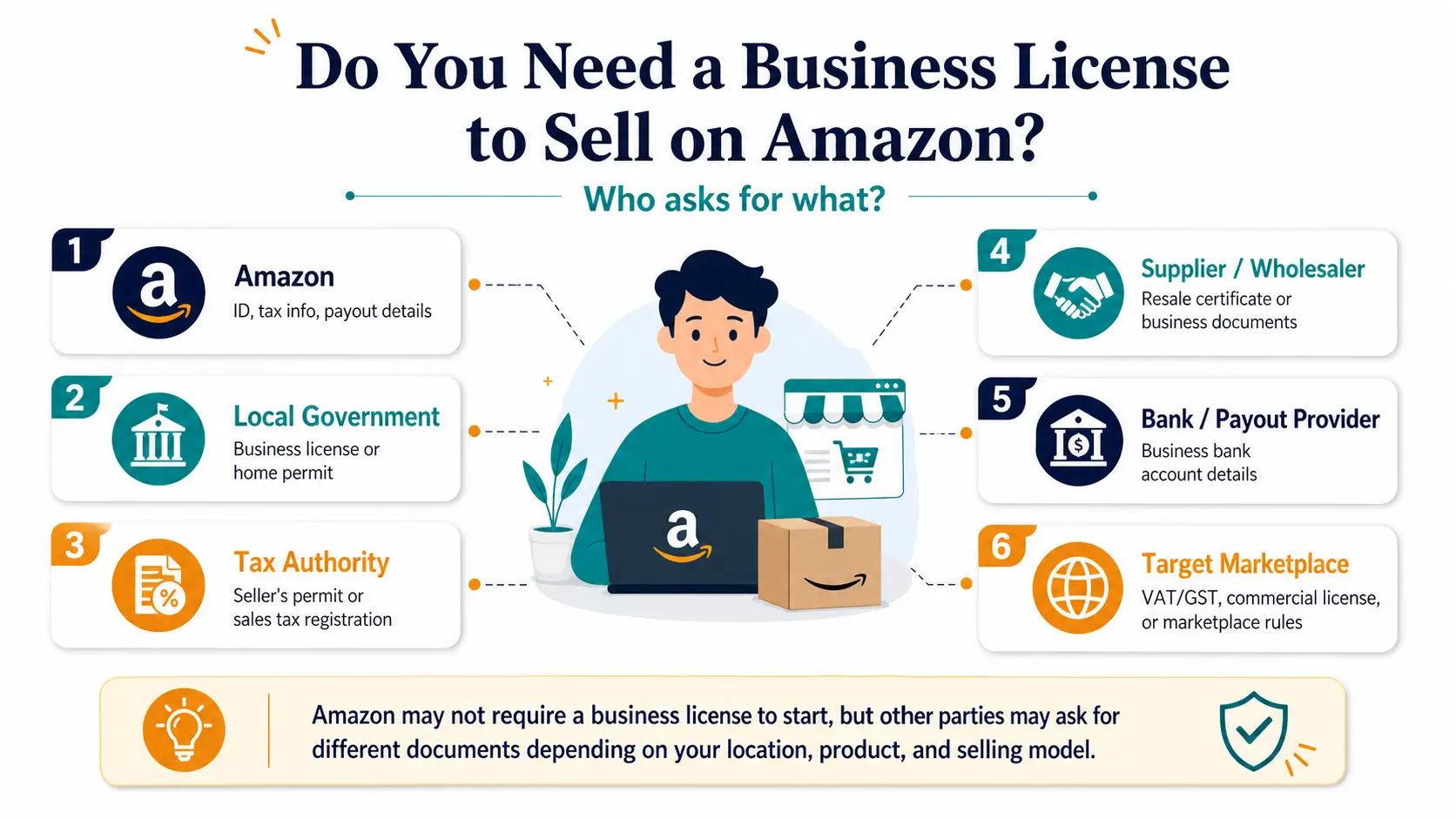
The Real Question: Who Is Asking for What?
The better question is not only, “Does Amazon require a business license?” The better question is: who may ask you for documents?
This is the difference many beginner sellers miss. Amazon seller account requirements, local business rules, tax registration, supplier approval, banking, insurance, and international marketplace rules are related, but they are not the same thing.
Here is a practical way to separate them:
| Who may ask? | What they may ask for | Why it matters |
|---|---|---|
| Amazon | Identity information, address, tax information, bank or payout details, chargeable card, business documents if applicable | Amazon uses this information to verify your seller account and reduce fraud risk. |
| Local government | Business license, home business permit, local registration, or operating permit | Your city, county, state, or country may have rules for operating a business. |
| State tax authority | Seller’s permit, sales tax permit, sales tax registration, or filing requirements | Tax rules can apply even when Amazon collects sales tax on some transactions. |
| Suppliers or wholesalers | Resale certificate, EIN, business documents, tax ID, or proof of business | Many wholesalers want proof that you are a legitimate reseller before opening an account. |
| Bank or payout provider | Matching legal name, business details, EIN, or business registration documents | Payment details need to match your seller account and business setup. |
| Insurance provider | Business structure, product details, sales volume, and commercial liability information | Insurance requirements may become more important as your sales and product risk increase. |
| International marketplace | Commercial license, VAT/GST registration, local tax number, or business documents | Amazon requirements can vary by marketplace, country, and seller type. |
This table is for general education only. The exact documents you need can vary by location, marketplace, product category, and business model.
This is why a generic answer like “you do not need a business license” can be incomplete. It may be true for opening a basic seller account in one marketplace, but not true for every country, product, supplier, or selling model.
What Amazon Actually Requires to Register
Amazon does not start by asking every seller for the same business license. Instead, it asks for information that helps verify your identity, location, payment setup, tax situation, and seller account details.
In general, Amazon seller registration may include:
- Business location or country where you are doing business from
- Business type, such as individual or registered business
- Seller identity information
- Phone number and email address
- Chargeable credit card or accepted payment method
- Bank account or supported payout method
- Tax information or tax interview details
- Store name and product information
- Government-issued ID and proof of address for verification
- Business documents if you register as a business entity
Notice something important: most of these are account verification requirements, not necessarily a business license.
If you register as an individual, Amazon may collect personal identification and tax information that applies to an individual seller. If you register as a business, Amazon may ask for business details such as legal business name, registration number, business address, or related documents.
Before worrying about licenses, first check whether your country can register and which marketplaces may be realistic for you. You can use our Amazon seller registration countries eligibility checker to see which marketplaces may be available and what documents or setup steps you may need.
Business License vs LLC vs EIN vs Seller Permit vs Resale Certificate
A lot of confusion comes from using several business terms as if they mean the same thing. They do not.
A business license, LLC, EIN, seller’s permit, resale certificate, and Amazon seller account are separate things. You may need one, several, or none of them depending on your situation.
When beginners search for an Amazon business license, they are usually asking whether Amazon itself requires a license, or whether a local government, tax authority, supplier, bank, or marketplace may ask for business documents. These are separate questions, and the answer depends on your location, product, and selling model.
| Term | What it means | Always required? |
|---|---|---|
| Business license | Permission from a city, state, country, or authority to operate a business. | No. It depends on your location, activity, product type, and business model. |
| LLC | A legal business entity that can separate the business from the owner when maintained properly. | No. Amazon does not require every seller to form an LLC. |
| EIN | A US federal tax identification number often used by businesses. | Depends. Often needed for an LLC or corporation, but not always required for an individual seller. |
| Seller’s permit / sales tax permit | State or local tax registration related to selling taxable goods. | Depends on your state, tax nexus, business model, and local rules. |
| Resale certificate | A document that may let you buy inventory for resale without paying sales tax upfront. | Not always. Often useful for wholesale or online arbitrage. |
| Amazon seller account | Your account inside Seller Central that lets you list and sell products on Amazon. | Yes. You need a seller account to sell on Amazon. |
| Business bank account | A separate account used to receive and manage business income and expenses. | Not always for individuals, but often smart and usually important if you form a company. |
If you are also confused about whether you need a company structure, read our full guide on whether you need an LLC to sell on Amazon. The short version is that an LLC is not required for every beginner, but it may make sense later depending on your risk, product, banking, partners, taxes, and long-term plans.
When You Probably Do Not Need a Business License Yet
Many beginners do not need to start by chasing licenses before they even know what they want to sell. If you are still learning, researching, and comparing ideas, your first job is usually to understand the business model, not to pay for every possible business document.
You probably do not need a business license yet if:
- You are only learning how Amazon selling works.
- You have not chosen a product yet.
- You have not opened a seller account yet.
- You are still checking whether your country is eligible for seller registration.
- You are comparing Amazon FBA, FBM, wholesale, arbitrage, or private label.
- You are not selling regulated products.
- You are not working with wholesalers that require business documentation.
- You are not operating a full commercial business from home or a physical location.
In my view, this is one of the biggest mistakes beginners make: they try to solve the legal setup before they understand the product, the costs, the fees, the demand, and the risk.
That does not mean you should ignore licenses forever. It means you should not let licensing become a distraction from the more important first questions: can you register, what will you sell, can the product make a profit, and what setup does your specific situation require?
When You May Need a Business License to Sell on Amazon
You may need a business license or related permit when your selling activity becomes more formal, more regulated, or more connected to local business rules.
You may need to check business license requirements if:
- Your city, county, state, or country requires local business registration.
- You operate a business from home and your area requires a home occupation permit.
- You sell regulated products such as food, supplements, cosmetics, medical products, children’s products, alcohol, tobacco, or hazardous goods.
- You want to work with wholesalers, distributors, or manufacturers that require business documents.
- You need a resale certificate or seller’s permit for your sourcing model.
- You operate under a business name different from your personal name.
- You are selling in a marketplace that requires local commercial registration.
- You are opening a business bank account, applying for business financing, or getting commercial insurance.
The key point is that these requirements usually come from your location, product, supplier, tax situation, or marketplace. They do not always come directly from Amazon as a universal rule.
Important: Do not assume that another seller’s setup applies to you. A seller in the US, UAE, UK, Canada, EU, or India may face different registration, tax, license, and business document requirements.
Do You Need a Seller’s Permit or Sales Tax Permit?
A seller’s permit or sales tax permit is not the same as a general business license.
A business license usually gives permission to operate a business in a certain jurisdiction. A seller’s permit or sales tax permit is usually connected to selling taxable goods and dealing with sales tax rules.
In the US, marketplace facilitator laws often mean Amazon calculates, collects, and remits sales tax on many marketplace orders. That can reduce the burden on sellers, but it does not automatically mean every seller has no registration or filing obligations.
Depending on your state, inventory location, business activity, and tax nexus, you may still need to register, file reports, or maintain a seller’s permit. This is especially important if you sell on other platforms, operate your own website, store inventory in certain places, or work with wholesale suppliers.
The safest approach is to check your state or local tax authority and speak with a qualified tax professional if you are unsure.
Do You Need a Resale Certificate to Sell on Amazon?
You do not always need a resale certificate to sell on Amazon, but it can be useful depending on your business model.
A resale certificate may allow you to buy inventory for resale without paying sales tax upfront. This can matter if you are doing wholesale, online arbitrage, retail arbitrage, or buying from domestic distributors that require proof you are a legitimate reseller.
For example, many serious wholesalers will not open an account for you unless you provide a resale certificate, seller’s permit, EIN, or business documents. They want to know that you are not just a regular consumer trying to buy wholesale inventory.
If you are a private-label beginner sourcing from overseas suppliers, a resale certificate may not be the first thing you need. If you are building a wholesale or arbitrage model, it may become much more important.
Do You Need an EIN or Tax ID to Sell on Amazon?
An EIN, or Employer Identification Number, is a US federal tax identification number used by businesses.
An EIN is not a business license. It does not give you permission to operate a business by itself. It is mainly used for tax, banking, hiring, and business identification purposes.
If you form an LLC, corporation, or another business entity, you will usually need an EIN. If you sell as an individual or sole proprietor, you may be able to use personal tax information instead, depending on your country and Amazon’s registration flow.
For non-US sellers, the tax setup can be different. Amazon may guide you through a tax interview or ask for information that applies to your country and marketplace.
The main point is simple: do not confuse EIN, LLC, business license, and Amazon seller account. They are separate pieces of the setup.
Do You Need a Business Bank Account to Sell on Amazon?
You may not always need a formal business bank account just to start as an individual seller, but separating your business and personal finances is usually a smart move as your selling activity becomes serious.
If you register as an individual, your payout setup may depend on your personal information and the payout methods Amazon supports for your country and marketplace. If you register as a business, your bank account and legal details should generally match the business information you provide.
A separate account can make bookkeeping, tax preparation, cash flow tracking, and expense management much easier. If you form an LLC or another business entity, keeping personal and business finances separate becomes even more important.
Still, a business bank account is not the same thing as a business license. It is part of managing your money, not proof by itself that you are licensed to operate in every jurisdiction.
Do You Need a Business License for Amazon FBA?
No, Amazon FBA does not automatically mean you need a business license.
FBA stands for Fulfillment by Amazon. It is a fulfillment method, not a legal business structure. It means Amazon stores your inventory, packs orders, ships products, and handles many customer service and return tasks.
However, FBA can make licensing and compliance questions more important because you are dealing with physical products, inventory storage, returns, product safety, category restrictions, tax rules, and sometimes sales tax nexus.
If you are still learning the broader process, start with our full guide on how to sell on Amazon FBA. It will help you understand the full path before you spend money on business setup, inventory, shipping, or advertising.
For many beginners, the best sequence is not “get every license first.” The better sequence is: understand the model, check eligibility, choose a simple product direction, estimate costs, then confirm what documents your exact setup requires.
US Sellers vs Non-US Sellers
Business license questions can look very different depending on where you live and which Amazon marketplace you want to sell in.
For US sellers, the main questions often involve local business registration, state sales tax rules, seller’s permits, resale certificates, product category restrictions, and whether to operate as an individual, sole proprietor, LLC, or corporation.
For non-US sellers, the questions can be different. You may need to think about country eligibility, identity verification, payout options, tax interviews, local business documents, VAT/GST registration, and whether your target marketplace accepts your setup.
This is why you should not blindly copy another seller’s setup. A seller in California, Morocco, the UAE, the UK, Canada, India, or Brazil may face different requirements.
If you are outside the US, check your seller registration path before spending money on company formation or licenses. The correct answer depends on your country, marketplace, documents, payout method, product type, and tax situation.
What If You Sell on Amazon UAE, UK, EU, or Other Marketplaces?
Do not assume that the rules for Amazon US apply everywhere.
Some marketplaces may allow individual registration in certain cases. Others may require additional business documents, tax registration, VAT/GST information, commercial registration, or local compliance steps depending on your seller type and activity.
For example, selling on Amazon UAE may involve commercial license questions for ongoing business activity. Selling in the UK or EU may involve VAT and other business documentation depending on where you are located, where inventory is stored, and how you sell.
This is where generic advice can become dangerous. “You do not need a business license” may be true in one situation and misleading in another.
The safer approach is to check the official Amazon registration requirements for your target marketplace and confirm local rules before committing to inventory or business formation costs.
Business License vs Amazon Seller Business Type
Another common confusion is between Amazon’s seller account choices and your legal business setup.
Amazon may ask you to choose a business type during registration. Amazon also offers Individual and Professional selling plans. These are not the same thing as having or not having a business license.
An Individual selling plan is a pricing plan. A Professional selling plan is also a pricing plan. A sole proprietor, LLC, or corporation is a legal or tax structure. A business license is permission from a government authority to operate in a certain way or location.
That means:
- Choosing the Individual selling plan does not automatically mean your legal structure is correct.
- Choosing the Professional selling plan does not automatically mean you need an LLC.
- Registering as an individual seller does not automatically remove local license or tax obligations.
- Registering as a business may require business documents that individual sellers do not provide.
For beginners, this distinction matters because it prevents you from making the wrong decision for the wrong reason.
What Beginners Should Do Before Applying for Licenses
If I were starting from zero, I would not begin by applying for random licenses just because someone in a forum said they were required. I would first map the situation clearly.
The question do you need a business license to sell on Amazon should come after you understand your country, marketplace, product category, and selling model.
Before applying for a business license, seller’s permit, resale certificate, EIN, or company formation, ask these questions:
- Can I register for an Amazon seller account from my country?
- Which Amazon marketplace do I want to sell in?
- Am I still learning, or am I ready to sell real inventory?
- Will I sell as an individual, sole proprietor, LLC, or another business entity?
- Does my city, state, or country require a business license for online selling?
- Does my product category require special approval, safety documents, or permits?
- Will I source from wholesalers who require a resale certificate?
- Will I store inventory at home, with Amazon FBA, or with a prep center?
- Do I need a separate bank account or payout method?
- Should I speak with a CPA, attorney, or local business advisor before spending money?
Also remember that business setup costs are only one part of the bigger Amazon FBA budget. Before paying for licenses, company formation, inventory, or tools, read our guide on how much it costs to start Amazon FBA so you can see the full launch picture.
Final Verdict: Do You Need a Business License to Sell on Amazon?
No, you usually do not need a business license just to open an Amazon seller account or start selling as a beginner. Amazon may allow you to register as an individual seller if you can meet the platform’s verification, payment, tax, and document requirements.
But that does not mean a business license is never needed. You may need one depending on your city, state, country, product category, supplier requirements, sales tax situation, target marketplace, or long-term business structure.
The best approach is not to ask only, “Does Amazon require a business license?” Ask the better question: “Who might require documents from me, and at what stage?”
So if you are asking, do you need a business license to sell on Amazon, the practical answer is: not always for Amazon itself, but you must check the rules that apply to your location, product, and business model.
If you are brand new, start by checking seller eligibility, understanding Amazon’s registration requirements, learning the selling process, and estimating your startup costs. Then decide which licenses, permits, tax registrations, or business documents actually apply to your specific situation.
Frequently Asked Questions
Here are common questions beginners ask about business licenses, seller permits, LLCs, EINs, resale certificates, and Amazon seller account requirements.
Usually no, you do not need a business license just to open an Amazon seller account or start selling as a beginner. Amazon does not require every ordinary seller to provide a business license just to create an account.
However, you may still need a business license, permit, tax registration, resale certificate, or business document depending on your location, product category, selling model, supplier requirements, and target marketplace.
In many cases, yes, you can sell on Amazon without a business license, especially if you register as an individual seller or sole proprietor and meet Amazon’s verification requirements.
That does not mean no other rules apply. Your city, state, country, tax authority, supplier, bank, product category, or target marketplace may still require permits, tax registration, a seller’s permit, a resale certificate, or other business documents.
Amazon does not generally require every seller to provide a business license. Amazon mainly verifies identity, address, payment method, payout method, tax information, and business documents if you register as a business entity.
No, you do not always need an LLC to sell on Amazon. Some beginners can start as individuals. An LLC may make sense later if you want better business separation, banking, tax flexibility, liability planning, partners, or long-term growth.
It depends on your state, tax nexus, selling model, and local rules. A seller’s permit is related to sales tax registration, not Amazon account creation itself. Some sellers may need one even if Amazon collects sales tax on many marketplace orders.
Not always. A resale certificate is often useful for wholesale or online arbitrage because suppliers may require it and it may let you buy inventory for resale without paying sales tax upfront.
If you form an LLC or corporation, you will usually need an EIN. If you sell as an individual or sole proprietor, you may be able to use personal tax information instead, depending on your country and Amazon’s registration process.
A business bank account may not be required for every individual seller, but separating personal and business money is often smart. If you register as a business or LLC, your bank account should generally match your business details.
FBA does not automatically require a business license. FBA is a fulfillment method, not a legal structure. But FBA may involve inventory storage, product compliance, returns, sales tax questions, and product category restrictions.
Not always. Non-US sellers should check country eligibility, marketplace requirements, payout options, tax information, and local business rules. Requirements can vary widely by country and Amazon marketplace.
Amazon UAE and UAE commercial rules can be different from Amazon US. Sellers may need to check whether a commercial license, eCommerce license, VAT registration, or other business documents apply to their situation.
Usually, beginners should first understand eligibility, product research, costs, fees, and risk. Licensing becomes more important when you know your product, marketplace, business model, and local requirements.
