
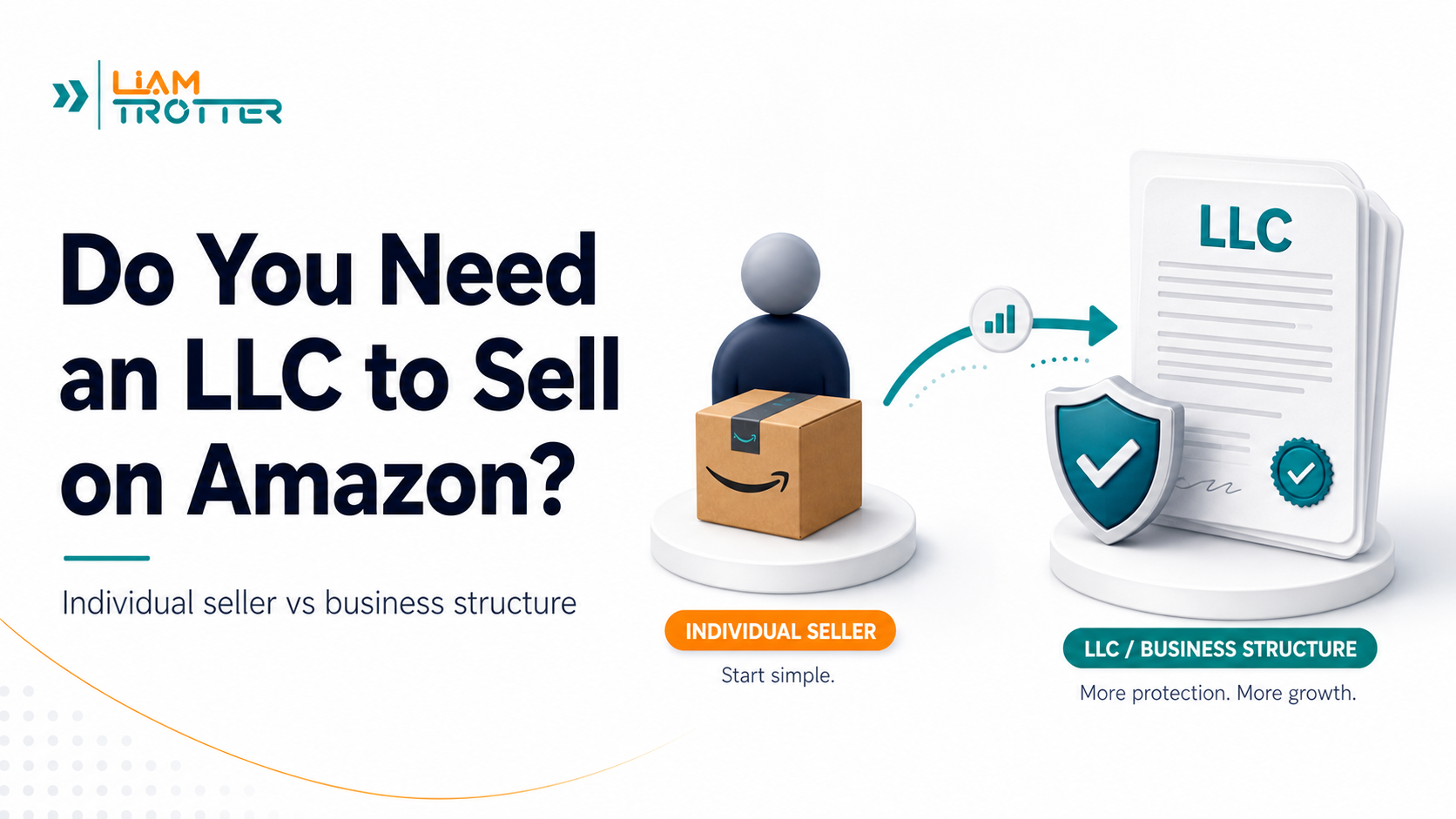

Do you need an LLC to sell on Amazon? The short answer is no. You do not need an LLC just to open an Amazon seller account or start selling as a beginner.
In many cases, you can start as an individual seller or sole proprietor, especially if you are still learning, testing products, or trying to understand whether Amazon FBA is a good fit for your budget.
However, that does not mean an LLC is useless. Forming an LLC may make sense later if you want better separation between personal and business finances, cleaner business banking, tax flexibility, a more professional business structure, partners, wholesale access, or a stronger foundation for a growing Amazon business.
The mistake many beginners make is thinking they must form a company before they can even start. That is not always true. The better question is not only “Do I need an LLC?” but “Do I need an LLC right now, based on my country, product, risk, budget, and business plans?”
This guide explains when you can sell on Amazon as an individual, when an LLC may be worth it, what Amazon actually requires, and how to decide which setup makes sense before spending money on inventory.
Quick Answer: Do You Need an LLC to Sell on Amazon?
No, you do not need an LLC to sell on Amazon. Amazon allows people to register as individuals if they are not operating through a registered business entity.
During seller registration, Amazon asks for your business type. If you are operating as an individual or your business is not incorporated, Amazon says you can select “None, I am an individual” and continue the registration process with the relevant information for your situation.
That means an LLC is not a required starting point for every beginner. You can usually begin learning the process, researching products, estimating costs, and even registering as an individual if your country, documents, payment method, tax information, and verification details meet Amazon’s requirements.
But an LLC can still be useful. It may help separate your personal and business finances, create a more formal business structure, improve credibility with banks or suppliers, and provide liability protection when used properly.
Simple rule: You do not need an LLC just to start selling on Amazon. But you may want one later if your Amazon business becomes serious, risky, profitable, or more complex.
This guide is for general education only and is not legal, tax, or financial advice. Business structure rules can vary by country, state, product type, and seller situation.
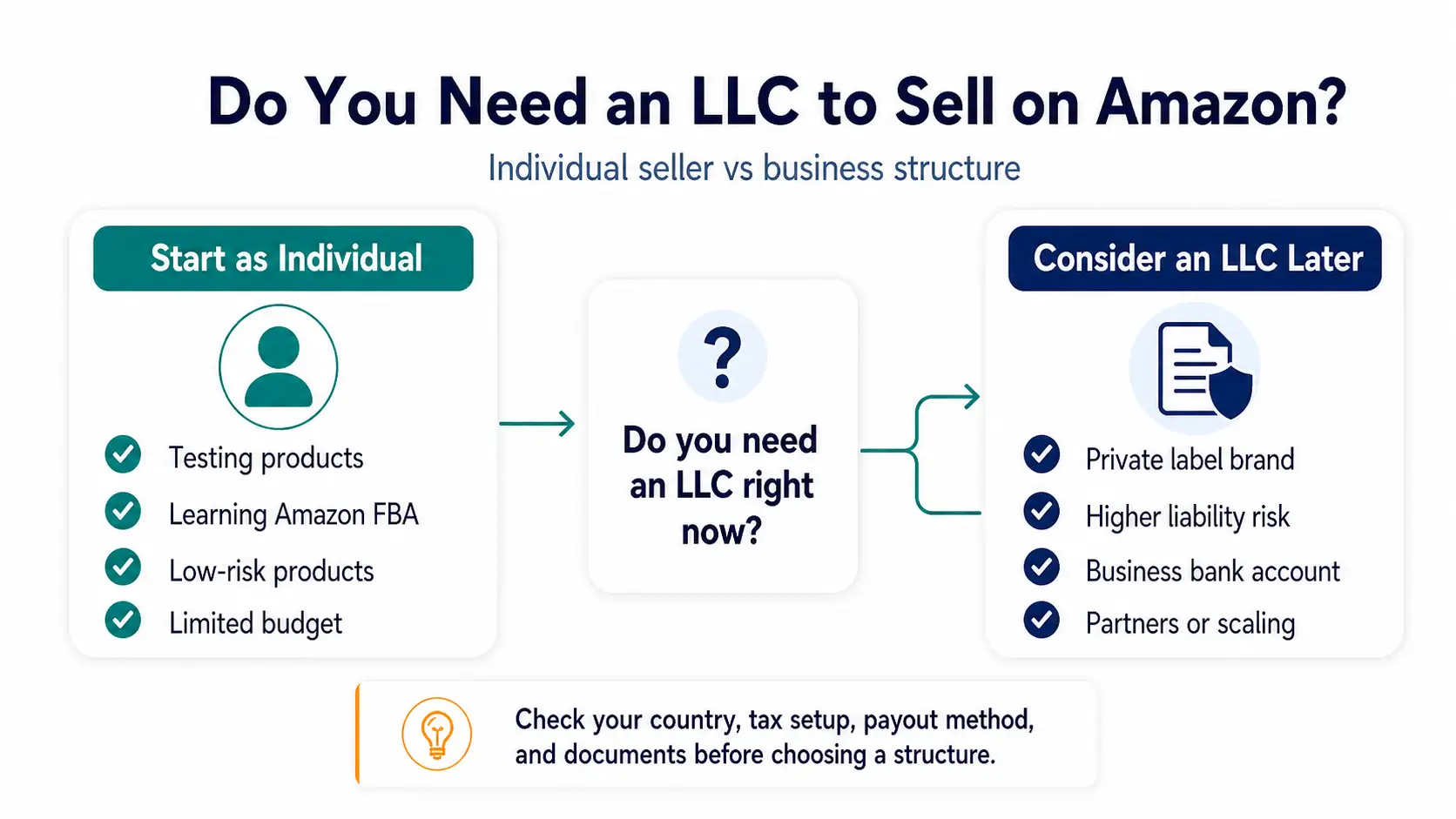
Can You Sell on Amazon Without an LLC?
Yes, you can sell on Amazon without an LLC. Many beginners start as individual sellers or sole proprietors before deciding whether to form a company.
This is common because forming an LLC takes money, paperwork, state filings, banking setup, and ongoing maintenance. If you have not chosen a product yet, have not validated demand, and are still learning how to sell on Amazon FBA, forming an LLC may not be the first thing you need to do.
Selling as an individual can be enough for the early stage. You can learn how Amazon works, understand product research, compare fees, estimate startup costs, and decide whether the business model is realistic before adding legal complexity.
The downside is that a sole proprietorship does not usually create a strong legal separation between you and your business. If something goes wrong, your personal assets may be more exposed than they would be under a properly maintained LLC.
So the question is not whether individual selling is possible. It is whether it is the right setup for your level of risk.
What Amazon Actually Requires to Register
Amazon does not start the registration process by requiring every seller to form an LLC. Instead, it asks for information that helps verify who you are, where you are doing business from, how you will pay fees, how you will receive payouts, and what kind of store you plan to operate.
In general, Amazon seller registration may include:
- Business location or country where you are doing business from
- Business type, such as individual or registered business
- Seller identity information
- Phone number and email address
- Bank account or supported payout method
- Chargeable credit card or accepted payment method
- Tax information or tax interview details
- Store name and product information
- Government-issued ID and proof of address for verification
If you are registering as a business, Amazon may ask for business details such as your legal business name, registration number, business address, and related documents. If you are registering as an individual, Amazon collects the information that applies to an individual seller instead.
This is why your first step should not always be “open an LLC.” Your first step should be to check whether you can register from your country and whether you can provide the documents, tax information, payment method, and payout setup Amazon may require.
Before choosing a business structure, use our Amazon seller registration countries eligibility checker to see which marketplaces may be available from your country and what documents or setup steps you may need.
Individual Seller vs LLC on Amazon
The biggest difference between selling as an individual and selling through an LLC is not whether Amazon allows it. Amazon can allow both. The difference is how your business is structured legally, financially, and operationally.
Here is a simple comparison:
| Factor | Individual / Sole Proprietor | LLC |
|---|---|---|
| Required by Amazon? | No. Amazon can allow individual registration if you meet the requirements. | No. An LLC is not required for every seller. |
| Startup cost | Usually lower because there is no company formation cost. | Higher because of state filing fees, possible registered agent fees, and ongoing costs. |
| Paperwork | Usually simpler. | More paperwork, including formation documents, EIN, operating agreement, and annual requirements. |
| Liability protection | Limited. You and the business are usually not strongly separated. | Stronger if the LLC is maintained properly and personal/business finances are kept separate. |
| Taxes | Usually simpler for very small sellers. | Can offer more flexibility, but may require professional tax guidance. |
| Business bank account | May not be required in every case, but separate bookkeeping is still recommended. | Strongly recommended to preserve separation between personal and business finances. |
| Best for | Testing, learning, low-risk products, and early-stage sellers. | Scaling, private label brands, partners, higher-risk products, wholesale, and long-term operations. |
This table is for general education only. Legal and tax rules can vary by country, state, product type, and business model.
An LLC can be useful, but it is not magic. It only helps if you run it correctly. That means keeping personal and business finances separate, using proper records, maintaining the LLC, and following tax and legal requirements.
When You Probably Do Not Need an LLC Yet
Many beginners do not need to form an LLC on day one. In fact, forming a company too early can distract you from the more important first questions: what will you sell, how much will it cost, what are the fees, and can the product make a profit?
You probably do not need an LLC yet if:
- You are still learning how Amazon FBA works.
- You have not chosen a product yet.
- You are still researching whether Amazon FBA is worth it for you.
- You want to test a low-risk product before committing to a larger setup.
- You do not have business partners.
- You are not dealing with regulated or high-liability products.
- You have a limited budget and need to prioritize product validation first.
In this stage, your time may be better spent learning product research, understanding Amazon FBA fees, estimating your first launch budget, and checking whether your country is eligible for seller registration.
That does not mean you should ignore legal structure forever. It means you should not let LLC formation become an excuse to delay the real work of understanding the business.
When an LLC May Be Worth It
An LLC may become worth it when your Amazon business moves from “testing” to “serious operation.” At that point, the benefits of structure, separation, and protection may become more important.
You may want to consider forming an LLC if:
- You are launching a private label brand and plan to sell long term.
- You are selling products with potential safety or liability risk.
- You have business partners or multiple owners.
- You want to open a dedicated business bank account.
- You want cleaner bookkeeping and separation between personal and business finances.
- You want to work with wholesalers, distributors, or larger suppliers.
- You need business insurance or may soon reach higher sales volume.
- You want a more professional structure for taxes, financing, or brand growth.
For example, selling a simple low-risk product as a small test is different from launching a supplement, electronic device, beauty product, children’s item, or anything that could create safety complaints or liability concerns.
The more risk your product carries, the more important it becomes to think carefully about legal structure, insurance, supplier documentation, product compliance, and quality control.
Important: An LLC does not protect you from every possible problem. It is not a substitute for safe products, proper insurance, tax compliance, accurate listings, or professional advice.
Do You Need an LLC for Amazon FBA Specifically?
Do You Need an LLC for Amazon FBA Specifically?
No, you do not need an LLC specifically for Amazon FBA.
Amazon FBA, or Fulfillment by Amazon, is a fulfillment method. It means Amazon stores, packs, ships, and handles many customer service tasks for your products. It is not a legal business structure.
When beginners search for an LLC for Amazon FBA, they are usually asking whether using FBA creates a separate legal requirement. It does not. The LLC question depends more on your product risk, business size, partners, banking, taxes, and long-term plans than on FBA alone.
You may be able to use FBA as an individual seller if you are eligible to register, can verify your account, and can meet the requirements for the marketplace where you want to sell.
However, FBA usually involves physical products, inventory, shipping, returns, customer complaints, and product liability risk. So while an LLC is not required just because you use FBA, it may become more attractive if you are building a real private-label business.
Before forming an LLC, it also helps to understand how much it costs to start Amazon FBA, because your legal setup is only one part of your total launch budget.
Do Non-US Sellers Need an LLC to Sell on Amazon US?
Not always. A non-US seller does not automatically need a US LLC just to sell on Amazon US.
The answer depends on your country, your documents, the marketplace you want to sell in, your tax situation, your payout method, and whether Amazon can verify your identity and account information.
Some international sellers choose to form a US LLC because it can make certain parts of the business easier, such as getting an EIN, opening a business bank account, working with certain providers, or creating a more formal business structure. But that does not mean every non-US seller should rush to open one.
Amazon also provides payout options and currency conversion support for some sellers outside the US, depending on supported countries, regions, and currencies. This means a US bank account or US company is not always the only possible path.
If you are outside the US, check your eligibility first. Then decide whether an LLC makes sense for your specific country, marketplace, tax position, and banking setup.
Use the Amazon seller registration countries eligibility checker to compare possible marketplaces before deciding whether you need a company structure.
Do You Need a Business License to Sell on Amazon?
A business license is not the same thing as an LLC.
This is where many beginners get confused. LLC, business license, EIN, resale certificate, and seller account are different things. They may be connected, but they are not the same.
Amazon does not require every ordinary seller to have a business license just to create an account. But depending on your product, location, business model, and local rules, you may still need licenses, permits, tax registration, or professional guidance.
For a deeper breakdown of this topic, read our full guide on whether you need a business license to sell on Amazon. It explains the difference between Amazon’s own requirements, local business rules, seller permits, resale certificates, EINs, and marketplace-specific documents.
For example, a seller doing wholesale may need a resale certificate to buy inventory from distributors. A seller operating from home may need to check local rules. A seller dealing with regulated products may need special approvals or licenses. A seller outside the US may face different tax or marketplace requirements.
Here is the simple difference:
| Term | What It Means | Always Required? |
|---|---|---|
| LLC | A legal business entity that can separate the business from the owner. | No. Amazon does not require every seller to form an LLC. |
| Business license | Permission to operate a business in a certain city, state, country, or industry. | Depends on your location, product type, and business model. |
| EIN | A US federal tax identification number for a business. | Usually needed for an LLC or corporation, but not always required for an individual seller. |
| Resale certificate | A document that may let you buy inventory for resale without paying sales tax upfront. | Often useful for wholesale or online arbitrage, but not required for every seller. |
| Amazon seller account | Your account inside Seller Central that lets you list and sell products. | Yes. You need a seller account to sell on Amazon. |
Do You Need an EIN to Sell on Amazon?
An EIN, or Employer Identification Number, is a federal tax ID used by businesses in the United States.
If you form an LLC or corporation, you will usually need an EIN for taxes, banking, and business setup. If you are selling as an individual or sole proprietor, you may be able to use your personal tax information instead, depending on your country and Amazon registration flow.
For US sellers, this may mean using an SSN as an individual or an EIN as a business. For non-US sellers, the tax setup can be different, so it is important to follow Amazon’s tax interview and speak with a qualified tax professional when needed.
The main point is simple: an EIN is not the same thing as an LLC. You may need an EIN if you form a business entity, but you do not automatically need an LLC just because you want to sell on Amazon.
Do You Need a Business Bank Account to Sell on Amazon?
Amazon requires billing and payout information, but whether you need a formal business bank account depends on how you register and what marketplace you sell in.
If you register as an individual, your payout method may be in your personal name or another supported setup, depending on Amazon’s requirements for your marketplace. If you register as a business or LLC, your bank account should generally match the business name and legal details you provide.
Even if a business bank account is not strictly required at the beginning, it is often smart to separate your Amazon income and expenses as soon as possible. Clean separation makes bookkeeping, tax filing, and cash flow tracking much easier.
If you form an LLC, a dedicated business bank account becomes especially important. Mixing personal and business funds can weaken the separation that makes an LLC useful in the first place.
Can You Change From Individual to LLC Later?
Yes, many sellers start as individuals and later update their business structure when the business becomes more serious.
This is one reason beginners should not panic about forming an LLC before they even understand the business model. You can often start simple, validate the opportunity, then form an LLC when there is a clear reason to do so.
However, changing your Amazon account information should be done carefully. Your legal name, business name, tax information, bank account, address, and documents need to match. Any mismatch can create verification problems or delays.
If you decide to change from individual to LLC later, do it when your documents are ready and your business information is consistent. If your account is already under review or verification, avoid making rushed changes without understanding the impact.
Should Beginners Form an LLC Before Selling on Amazon?
Most beginners do not need to form an LLC before they even start product research. At that stage, your biggest risk may not be legal structure. It may be choosing the wrong product, underestimating fees, ordering too much inventory, or launching without enough budget.
If you are still learning, focus first on:
- Checking whether your country is eligible for seller registration
- Understanding the Amazon FBA process
- Estimating your startup budget
- Learning Amazon fees and profit margins
- Researching product demand and competition
- Understanding whether Amazon FBA is worth it for your situation
Once you have a product direction, a real budget, and a serious plan, then it may make sense to speak with a CPA, attorney, or business formation professional about whether an LLC is worth it.
If you are still unsure whether the business model itself makes sense, read our guide on whether Amazon FBA is worth it before spending money on company formation, tools, or inventory.
Final Verdict: Do You Need an LLC to Sell on Amazon?
No, you do not need an LLC to sell on Amazon. Amazon can allow individual sellers to register and sell without forming a formal business entity.
But that does not mean every seller should stay an individual forever. An LLC may be useful if you are building a real brand, selling higher-risk products, working with partners, opening business banking, applying for insurance, or scaling into wholesale or larger inventory orders.
The best approach is to start with the right question. Do not ask only, “Do I need an LLC?” Ask: “What is the simplest safe structure for my country, marketplace, product, budget, and risk level?”
If you are brand new, check your eligibility first, understand the full Amazon FBA process, estimate your costs, and learn the fee structure. Then decide whether forming an LLC is the right next step for your Amazon business.
Frequently Asked Questions
Here are common questions beginners ask about selling on Amazon as an individual, forming an LLC, business licenses, EINs, and seller account requirements.
No, you do not need an LLC to sell on Amazon. Many sellers can start as individuals or sole proprietors if they meet Amazon’s registration and verification requirements.
An LLC may become useful later for liability planning, banking, taxes, partners, supplier relationships, or long-term business growth.
Yes, you may be able to sell on Amazon as an individual if your country is accepted for seller registration and you can meet Amazon’s identity, payment, tax, phone, and document verification requirements.
No, you do not need an LLC just because you use Amazon FBA. Amazon FBA is a fulfillment method, not a legal business structure.
When beginners search for an LLC for Amazon FBA, they are usually asking whether using FBA creates a separate legal requirement. It does not. The LLC question depends more on your product risk, business size, partners, banking, taxes, supplier needs, and long-term plans than on FBA alone.
An LLC may still make sense later if your Amazon FBA business becomes more serious, risky, profitable, or complex.
Not always. Amazon does not require every basic seller to have a business license, but your location, product category, business model, or local rules may require licenses, permits, tax registration, or a resale certificate.
If you form an LLC or corporation, you will usually need an EIN. If you sell as an individual or sole proprietor, you may be able to use personal tax information instead, depending on your country and Amazon registration process.
A business bank account may not be required for every individual seller, but it is strongly recommended if you form an LLC. Keeping personal and business funds separate helps with bookkeeping, taxes, and liability protection.
In some cases, yes. A non-US citizen does not automatically need a US LLC to sell on Amazon. The answer depends on country eligibility, marketplace requirements, verification documents, tax setup, and payout options.
If you are testing a low-risk idea, selling as an individual may be simpler. If you are building a serious brand, selling higher-risk products, working with partners, or scaling revenue, a business structure such as an LLC may be better.
Many sellers start as individuals and later update their business information. If you do this, make sure your legal name, business name, bank account, tax details, address, and documents match to avoid verification issues.
Usually no. If you are still learning and have not chosen a product, focus first on eligibility, product research, costs, fees, demand, and risk. Consider forming an LLC once you have a serious product plan or a clear business reason.
No, an LLC is not automatically required just because you use a dropshipping model. However, Amazon has strict dropshipping rules, and your business structure, suppliers, taxes, and local requirements can still matter.
Before choosing dropshipping, make sure your setup follows Amazon’s policies and your local business rules. An LLC may be useful later, but it does not make a non-compliant dropshipping setup acceptable.
